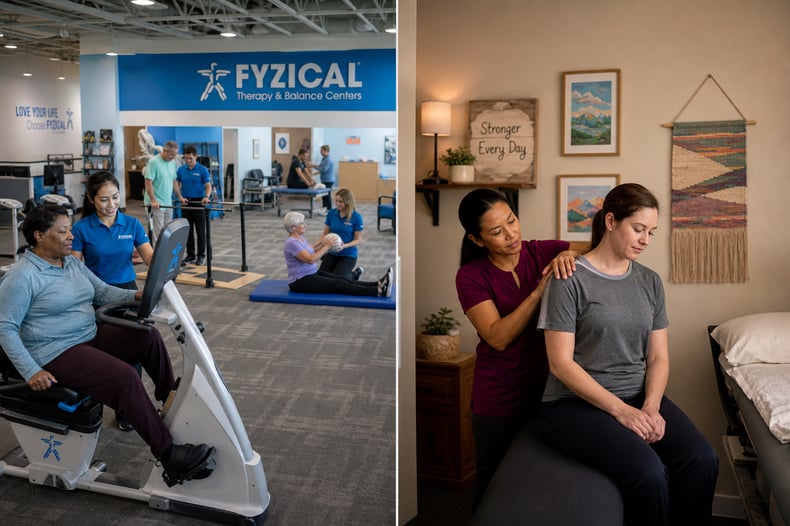
Opening a physical therapy practice is one of the most significant decisions you'll make in your career. The path you choose—physical therapy franchise or independent clinic—will shape your profitability, growth potential, and daily operations for years to come. This guide breaks down the key differences between franchise and independent ownership to help you make an informed decision about your future.
With the physical therapy industry projected to reach $128 billion by 2032, prospective practice owners have an unprecedented opportunity. But the business model you select will determine how much of that growth you capture.
Key Takeaways: Physical Therapy Franchise vs Independent Clinic
- A physical therapy franchise gives you proven systems, brand recognition, and operational support that reduce startup risk and accelerate profitability.
- Independent clinics offer complete autonomy but require you to build every system, vendor relationship, and marketing strategy from scratch.
- FYZICAL franchisees benefit from proprietary balance therapy programs that create additional revenue streams unavailable to independent practice owners.
- Multi-unit expansion is significantly easier with franchise infrastructure, where 47% of FYZICAL owners operate multiple locations.
- Exit strategies and practice valuations are typically stronger for franchise locations due to established brand equity and transferable systems.
What Is a Physical Therapy Franchise?
A physical therapy franchise is a business model where you own and operate your clinic under an established brand's systems, training, and support structure. You maintain clinical autonomy while gaining access to proven operational frameworks that have been refined across hundreds of locations.
The franchise model addresses one of the biggest challenges in private practice ownership: the learning curve. Rather than spending years figuring out what works through trial and error, you implement systems that have already generated results for other owners.
Most franchises offer territory exclusivity, meaning you won't compete with another owner operating under the same brand in your immediate market. This protection helps ensure your marketing investments drive patients to your door, not a neighboring location.
What Is an Independent Physical Therapy Clinic?
An independent clinic is a practice you build entirely from the ground up. You create your own brand, develop your own systems, negotiate your own vendor contracts, and establish your own marketing strategies. Every decision rests on your shoulders.
This model appeals to practitioners who want complete control over every aspect of their practice. You can name your clinic anything you want, design your space however you prefer, and pivot your business direction without consulting anyone.
The tradeoff is significant. Building brand recognition takes years of consistent effort and substantial marketing investment. And when something goes wrong—a billing issue, a staffing challenge, a compliance question—you have to solve it yourself or pay consultants for guidance.
How Do Startup Costs Compare?
Both franchise and independent clinics require substantial initial investment. The total dollar amounts can be similar, but where those dollars go differs considerably.
Franchise Investment Breakdown
When you invest in a franchise, your capital goes toward: the franchise fee (which grants you access to the brand and systems), build-out and equipment, initial marketing, and working capital. FYZICAL's total startup investment ranges from $217K to $518K, with franchise fees starting at $49K for a single unit.
The franchise fee isn't just a brand license. It buys you training programs, operational manuals, vendor relationships, and ongoing support. These resources would cost far more to develop independently.
Independent Clinic Investment
Independent clinic owners invest in similar categories: location buildout, equipment, marketing, legal setup, and working capital. But they also invest something equally valuable: time spent on trial and error.
Without proven systems, independent owners often spend their first years testing what works. A marketing campaign that flops, a billing process that creates collection problems, or an inefficient patient flow—these mistakes cost money and delay profitability.
Which Model Offers Better Profitability?
Profitability depends on revenue generation and expense management. Franchise systems typically provide advantages in both areas, though results vary based on owner execution and market conditions.
Revenue Advantages of Franchise Ownership
Franchise systems often achieve faster patient acquisition because of brand recognition. Patients searching for physical therapy services are more likely to choose a name they recognize over an unknown practice.
FYZICAL's proprietary Balance Paradigm creates an additional revenue advantage. Balance and vestibular therapy services serve a massive patient population—over 63 million Americans need balance therapy—and generate ancillary revenue that independent clinics simply cannot access without developing their own specialized programs.
Expense Management Benefits
Franchise systems negotiate vendor contracts at scale, passing savings to individual owners. Equipment, software, supplies, and marketing materials cost less when purchased through a network of hundreds of locations.
Independent owners negotiate alone, often paying retail prices or near-retail rates. These higher costs directly reduce profit margins on every patient visit.
How Does Operational Support Differ?
The support structure represents one of the starkest differences between franchise and independent ownership models.
Franchise Support Systems
Quality franchise systems assign dedicated support personnel to help owners succeed. This includes field representatives who visit your clinic, marketing teams who develop campaigns, and operations experts who troubleshoot challenges.
FYZICAL's training program includes 24+ hours of classroom training, immersive lab experiences, on-site education at your clinic, and ongoing virtual learning. Area representatives guide you through setup, opening, and growth phases.
When you face a challenge—staffing issues, insurance denials, marketing questions—you have experts to call. You're running your own business, but you're not running it alone.
Independent Practice Resources
Independent owners must build their own support network. This typically means hiring consultants, joining professional associations, or networking with other practice owners who may or may not share useful information.
The cost of this approach extends beyond dollars. Time spent researching solutions, attending conferences, and troubleshooting problems is time not spent treating patients or growing your practice.
What About Clinical Autonomy?
A common misconception holds that franchise ownership means sacrificing clinical decision-making. The reality is more nuanced.
Quality healthcare franchises maintain strict standards for patient care while preserving your clinical judgment. You follow evidence-based protocols and proven treatment approaches, but you're still the clinician making decisions for each patient.
FYZICAL franchisees can add services based on their expertise and market needs—pelvic health, aquatic therapy, TMJ treatment, and more. The franchise encourages service expansion that aligns with owner strengths and patient demand.
Independent owners have complete clinical freedom, but that freedom includes the freedom to make costly mistakes. Without established protocols and peer guidance, you may spend years developing treatment approaches that a franchise system has already optimized.
How Do Marketing Approaches Compare?
Patient acquisition is essential for practice success. How you attract patients looks very different depending on your ownership model.
Franchise Marketing Advantages
Franchise systems provide turnkey marketing resources: campaign templates, social media content, email sequences, and brand assets. You don't start from zero—you implement strategies that have proven effective across multiple markets.
Brand recognition accelerates results. A patient searching "physical therapy near me" is more likely to click on a familiar name. FYZICAL reports that 94% of franchisee websites rank #1 in their local market for "Physical Therapists Near Me."
Marketing support also includes physician liaison guidance. Building referral relationships with doctors is essential for practice growth, and franchise systems provide the training and materials to make those conversations productive.
Independent Marketing Challenges
Independent owners build marketing capabilities from scratch. This includes developing brand identity, creating a website, establishing social media presence, producing content, and learning digital advertising.
The learning curve is steep. Many independent owners underinvest in marketing or invest in tactics that don't generate returns. Without data from other locations showing what works, marketing becomes expensive experimentation.
Which Model Supports Better Growth?
If your ambition extends beyond a single location, the ownership model you choose will significantly impact your expansion potential.
Multi-Unit Franchise Growth
Franchise systems are built for scalability. The same systems that helped you open your first location work for your second, third, and beyond. You're not reinventing processes—you're replicating proven success.
Multi-unit ownership with FYZICAL allows you to share resources across locations: administrative staff, marketing budgets, and management oversight. This economy of scale improves profitability as you grow.
The numbers demonstrate franchise growth potential. According to FYZICAL, 47% of their franchisees operate multiple units. The WebPT State of Rehab Therapy report found that only 14.9% of practice owners surveyed own 10+ locations—a statistic that favors owners with systematic growth support.
Independent Practice Expansion
Independent owners can grow to multiple locations, but each new clinic requires building systems from scratch. What worked at your first location may not transfer smoothly to different markets, staff, or patient populations.
Without franchise infrastructure, multi-location management becomes increasingly complex. Maintaining consistent quality, training new staff, and managing finances across sites requires capabilities that independent owners must develop themselves.
What Are the Long-Term Ownership Considerations?
Your choice between franchise and independent ownership affects not just your daily operations but your long-term financial outcomes.
Exit Strategy and Practice Valuation
Every practice owner eventually transitions out of the business—through sale, partnership, or retirement. How you structure your ownership affects the value you can capture at exit.
Franchise locations often command higher valuations because buyers acquire proven systems along with the patient base. The brand recognition, operational manuals, and ongoing support transfer to new owners, reducing their risk and increasing their willingness to pay.
Independent practices sell based primarily on patient volume and practitioner reputation. When the original owner leaves, some of that value disappears—particularly if the practice was built around a single clinician's name.
Financial Freedom and Lifestyle
Your ownership model affects more than your bank account. It shapes how you spend your time and energy throughout your ownership journey.
Franchise systems free you from building everything yourself. Marketing support, operational guidance, and proven systems mean you spend more time on patient care and strategic growth, less time on administrative problem-solving.
Independent ownership means wearing every hat. You're the clinician, the marketer, the HR manager, the accountant, and the strategist. Some owners thrive in this environment. Others burn out trying to excel in roles they never trained for.
How Do You Evaluate Which Model Fits Your Goals?
The right choice depends on your specific circumstances, ambitions, and preferences. Consider these factors as you evaluate your options.
Assess Your Risk Tolerance
Franchise ownership reduces but doesn't eliminate risk. You're implementing proven systems rather than testing unproven theories. If you prefer reducing unknowns, franchising aligns with your risk profile.
Independent ownership involves more uncertainty. You may achieve spectacular results—or you may spend years struggling with challenges a franchise system would have helped you avoid. If you're comfortable with higher variance in outcomes, independence may suit you.
Consider Your Growth Ambitions
If you want to own one clinic and treat patients directly for your entire career, either model can work. But if you envision building a multi-location practice or eventually stepping back from clinical work, franchise infrastructure provides significant advantages.
Franchise territory development offers clear pathways from single-unit ownership to regional presence. The systems scale, the support continues, and the brand equity compounds as you grow.
Evaluate Your Business Background
Physical therapy education prepares you for clinical excellence, not business management. If you lack business experience, franchise systems fill critical knowledge gaps through training and ongoing support.
Experienced entrepreneurs may feel constrained by franchise guidelines. If you've built successful businesses before and want to apply your expertise without external input, independence offers that freedom.
What Questions Should You Ask Before Deciding?
Before committing to either path, gather information that will inform your decision.
Questions for Franchise Evaluation
Request the Franchise Disclosure Document (FDD) from any franchise you're considering. This legal document details fees, financial performance, franchisee obligations, and company history. Review it carefully, ideally with an attorney experienced in franchise law.
Speak with current franchisees. Ask about their experience with support, their path to profitability, and whether they would make the same choice again. Franchises that facilitate these conversations demonstrate confidence in their franchisee satisfaction.
Questions for Independent Planning
If you're considering independent ownership, honestly assess your capabilities. Do you have the business skills to manage finances, marketing, operations, and compliance? Do you have the time to develop these capabilities while also treating patients?
Research your local market thoroughly. How many physical therapy practices already operate in your area? What differentiates successful practices from those that struggle? Can you replicate those success factors without external support?
In Conclusion: Choosing the Right Path for Your Physical Therapy Career
The decision between franchise and independent ownership shapes your professional life for years or decades. Neither model is universally superior—the right choice depends on your goals, resources, and preferences.
Franchise ownership with an established brand like FYZICAL offers reduced risk, faster profitability, and systematic support for growth. You benefit from proven systems, proprietary services like balance therapy, and a community of fellow owners who share insights and solve problems together.
Independent ownership offers complete autonomy and the satisfaction of building something entirely your own. But that freedom comes with responsibility for every aspect of practice development and management.
Your next step is gathering information. Contact FYZICAL to explore franchise opportunities, request an FDD, and speak with current owners. The more you learn, the more confident you'll be in your decision.
FAQs About Physical Therapy Franchise vs Independent Clinic
How long does it take to become profitable with a franchise versus an independent clinic?
Franchise systems typically achieve profitability faster due to brand recognition and proven operational systems. FYZICAL franchisees have reported profitability in as little as two months, while independent practices often require one to three years to reach consistent profitability.
Can I add my own specialty services to a physical therapy franchise?
Yes, quality franchises encourage service expansion based on owner expertise and market demand. FYZICAL supports franchisees adding pelvic health, aquatic therapy, TMJ treatment, and other specialties. You maintain clinical autonomy while benefiting from franchise support.
What ongoing fees do physical therapy franchises charge?
Most franchises charge ongoing royalty fees as a percentage of revenue, plus marketing fund contributions. FYZICAL's ongoing support includes field representatives, marketing resources, training updates, and peer networking. Review the FDD for specific fee structures before investing.
Is a physical therapy franchise a good investment for non-clinicians?
FYZICAL welcomes owners from business, investment, and entrepreneurial backgrounds who partner with licensed clinicians. The franchise model supports non-clinical owners through operational training and clinical resources that ensure quality patient care.
How do exit strategies differ between franchise and independent clinics?
Franchise locations often sell at higher valuations because buyers acquire proven systems, brand recognition, and ongoing support along with the patient base. FYZICAL builds exit strategy planning into its franchisee support, helping owners maximize practice value for future transitions.